

To follow up on my sleep article, here is an instagram post worth sharing.
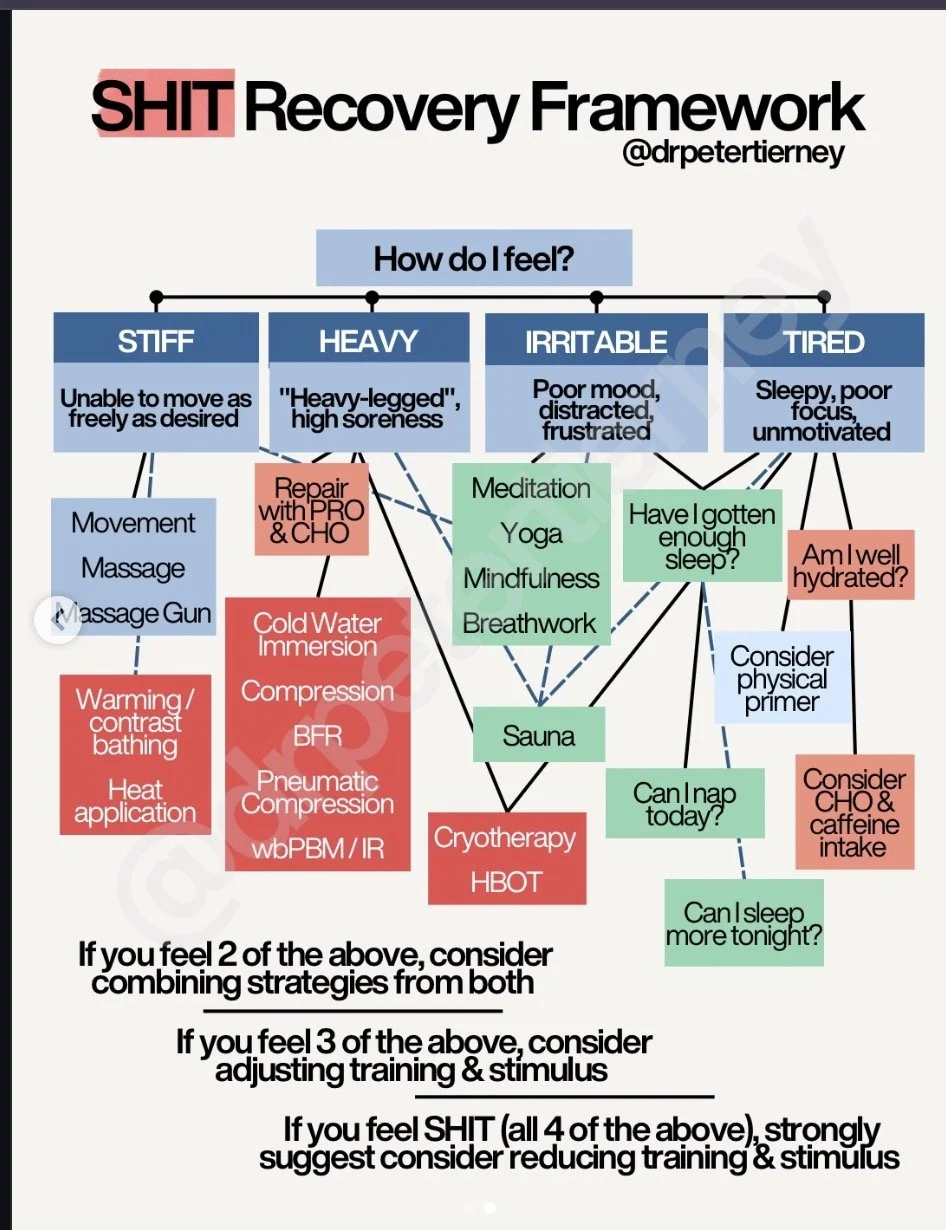
The SHIT recovery framework!
Yes, it may be crass - but so am I.
Dr Peter Tierney offers up an action plan for how you feel.
Most recovery advice reads like a menu: cold tubs, compression boots, red light, massage guns, sauna.
Everything is presented as good for everyone, all the time. The harder question is the one athletes and coaches actually face each morning: given how I feel right now, what should I do about it?
That's the gap Dr. Peter Tierney's S.H.I.T. Recovery Framework tries to fill. It's a simple decision tree you can run in a minute at your morning check-in, with the intention of training that day.
What S.H.I.T. stands for
The acronym is a four-part check on how you feel:
Stiff: unable to move as freely as you'd like.
Heavy: heavy-legged, with high soreness.
Irritable: poor mood, distracted, frustrated.
Tired: sleepy, poor focus, unmotivated.
It's crude, but you'll remember it.
First, some ground rules
Before you reach for any tool in this framework, a few caveats from Tierney matter as much as the chart itself:
The basics come first. This tree is a useful addition when overall good recovery behaviors (sleep, nutrition, long-term stress management) are already in place. It does not replace them.
It's built for competing athletes. The context is in-season, not pre-season or base building.
Think through the bigger questions. What are my current goals? What do I need to recover from? When do I need to be recovered by? How do I feel?
It's high level. Recovery is complex, and no single chart can hold every answer.
Matching the strategy to the symptom
If you feel stiff
The goal is to restore movement. Options include general movement, massage, or a massage gun, and heat-based approaches like warming or contrast bathing and direct heat application.
If you feel heavy
This is the heavy-legged, sore profile, and it has the widest toolbox. Start with fueling the repair process: protein (PRO) and carbohydrate (CHO). From there, the options include:
Cold water immersion
Compression, including pneumatic compression
Blood flow restriction (BFR)
Whole body photobiomodulation / infrared (wbPBM / IR)
Cryotherapy
Hyperbaric oxygen therapy (HBOT)
A note on HBOT: Tierney describes the evidence as emerging, particularly for return from injury, and says it's something he has prescribed to professional athletes to support recovery.
If you feel irritable
Irritability points toward the nervous system rather than the muscles. The tools here are downregulating ones: meditation, yoga, mindfulness, breathwork, and sauna. It's also worth asking whether you've gotten enough sleep.
If you feel tired
Before buying anything, ask the basic questions:
Have I gotten enough sleep?
Can I nap today?
Can I sleep more tonight?
Am I well hydrated?
Should I look at my carbohydrate and caffeine intake?
There's also an interesting option here: a physical primer. Primers are exercises prescribed to produce an acute performance boost. They're typically high intensity and low volume, such as jumps, plyometrics, resisted sled sprints, or heavy resistance work. If you're sluggish but not wrecked, a well-chosen primer can wake the system up before the main session.
When more than one box is checked
The symptom count is what makes this a framework rather than a list:
Two of the four: consider combining strategies from both categories.
Three of the four: consider adjusting training and stimulus.
All four (you feel S.H.I.T.): strongly consider reducing training and stimulus.
This is the most important part. Recovery modalities help when you're a little off. When you're stiff, heavy, irritable, and tired, no modality substitutes for training less. The right call may be backing off the session, not stacking another recovery tool on top of it.
Why this approach is useful
For athletes, it replaces "what's the best recovery method?" with "what's the best recovery method for this situation?" For coaches, it gives a shared language for talking with athletes about how they feel and which active recovery strategies make sense on a given day.
As with any framework like this, treat it as a conversation starter, not a prescription. It doesn't account for injury, your individual history, or where you are in your season, and that's where an individualized plan matters.
Key terms
PRO: protein
CHO: carbohydrates
BFR: blood flow restriction
IR / wbPBM: infrared / whole body photobiomodulation
HBOT: hyperbaric oxygen therapy
Physical primer: a high-intensity, low-volume exercise used to acutely enhance performance